Topics of the 2026 report:
Implementation of the High-Tech Agenda Germany
Topics of the 2026 report:
Security-related Research and Innovation
Topics of the 2026 report:
European R&I-Policy
Topics of the 2026 report:
A 28th Regime for the European single market
Topics of the 2026 report:
Innovation in German Mittelstand
Topics of the 2026 report:
Competition and Innovation in the German Higher Education System
Topics of the 2026 report:
Development and application of artificial intelligence in Germany and Europe
R&I-Dashboard:
Current indicators for Germany as a R&I location

Take risks. Move faster. How Germany and Europe are leading the way in technology.

EFI is a co-organiser of the 2026 Summit for Research and Innovation.

How can Germany and Europe move more quickly from ambition to implementation when it comes to disruptive technologies? What levers can accelerate technology transfer, scaling and market launch? And how can concrete lessons be drawn from successful projects for policymakers, academia and industry.

The programme of the 2026 Summit addresses these questions – with policy impetus for the implementation of strategic goals, lightning talks featuring key figures from successful innovation projects, and a discussion of international experiences and transferable success factors. Together with leading voices from politics, academia and industry, we will discuss what is specifically required to achieve greater courage and speed in technological leadership.

On-site participation is by invitation only. The summit will be livestreamed. You can find the link and further information on the programme and guests on the Summit for research and innovation website.

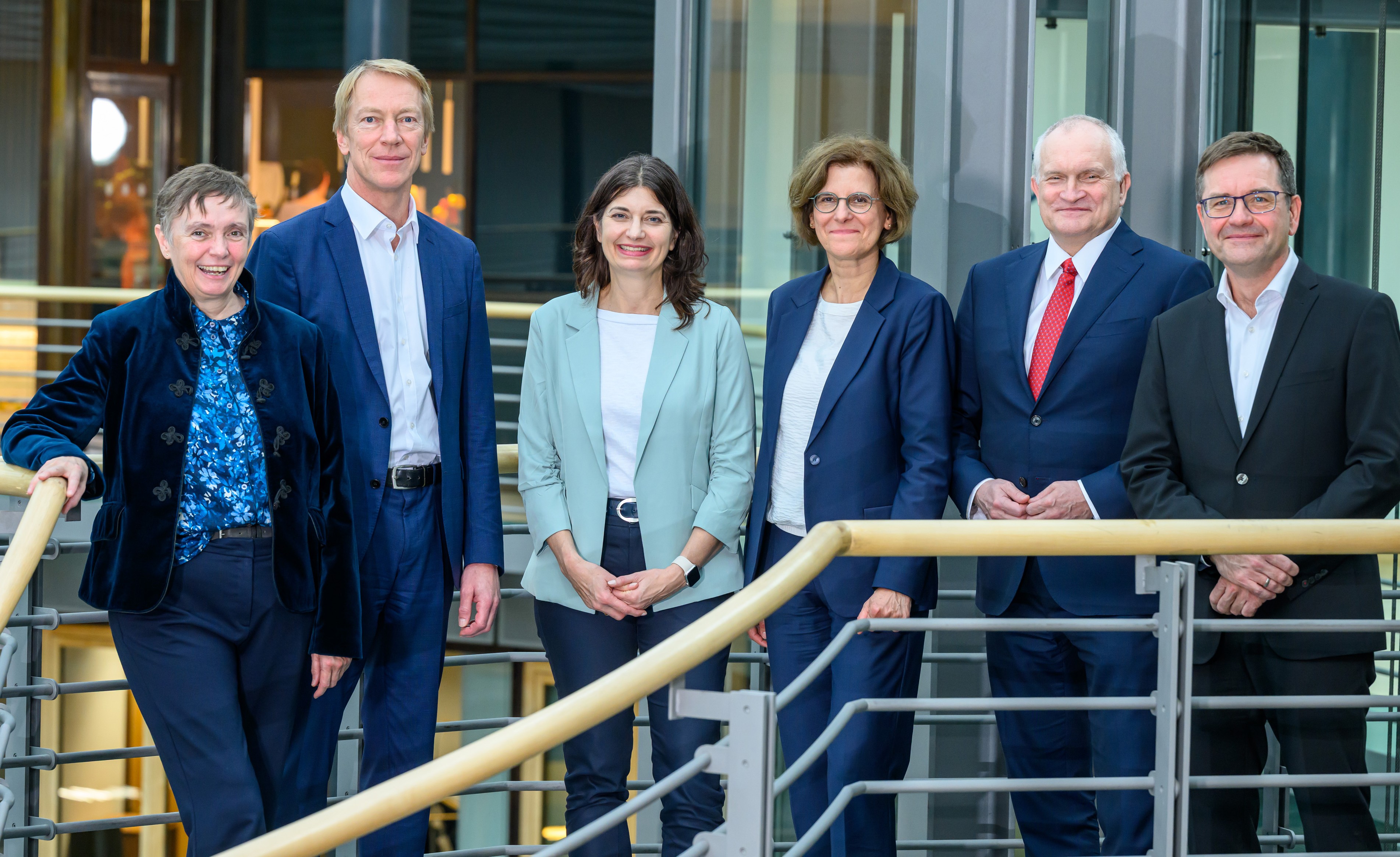
Commission of Experts

The Commission of Experts for Research and Innovation (Expertenkommission Forschung und Innovation - EFI) provides scientific policy advice to the Federal Government and regularly submits reports to it on research, innovation and Germany’s technological performance. The EFI’s core task is to analyse the strengths and weaknesses of the German innovation system in an international comparison and to assess the prospects for Germany as a centre of research and innovation. On this basis, the EFI develops recommendations for national research and innovation policy. The EFI was established in 2011 by a decision of the Federal Government to carry out its advisory mandate independently.

In this year’s report, the commission of experts examines the following topics:
 

  • Implementation of the High-Tech Agenda Germany
  • security-related Research and Innovation
  • European R&I-Policy
  • A 28th Regime for the European single market
  • Innovation in German Mittelstand
  • Competition and Innovation in the German Higher Education System
  • Development and application of artificial intelligence in Germany and Europe

EFI's R&I Dashboard

The R&I Dashboard provides access to the core indicators updated for the 2026 reporting year and the R&I monitoring of Germany's competitive position in selected technology areas such as artificial intelligence, microelectronics and biotechnology. It also contains indicators on Germany's technological performance. 
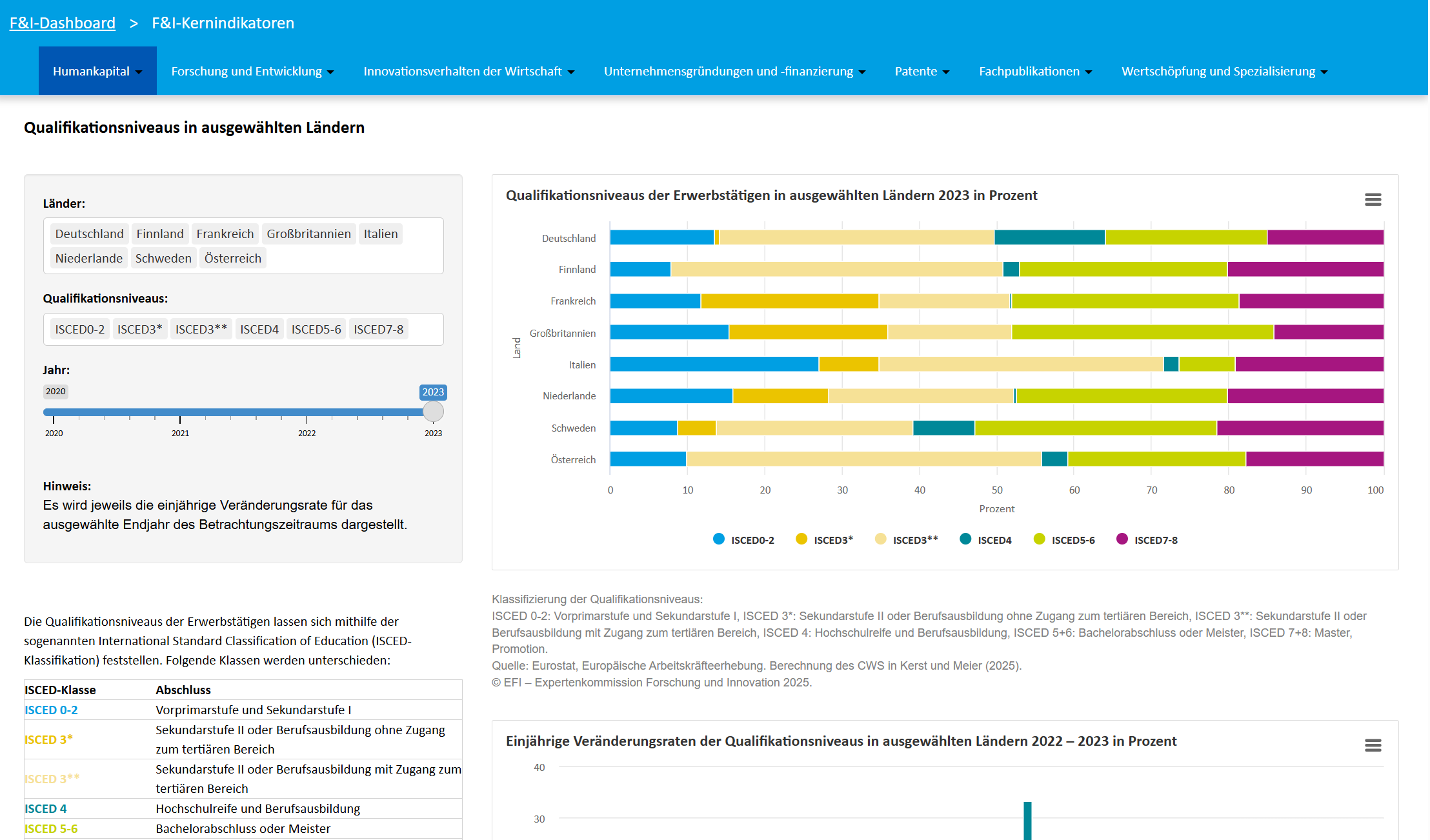
Table A 3-1 (2025)
Different Types of Industrial Policy zip (16,52 KB)
Infographic B 1 (2025)
Transformative Structural Change Through Digitalization and Decarbonization zip (133,74 KB)
Figures B 1-1 (2025)
Transnational patent applications of selected countries 2000 – 2021 in percent zip (45,08 KB)
Figures B 1-3 (2025)
Employment by digitalization potential and environmental relevance of occupations 2013–2022 in percent zip (39,47 KB)
Figures B 1-4 (2025)
Share of filed digitalization patents as a percentage of all filed patents per district in the periods 2000–2010 and 2011–2021 zip (755,29 KB)
Figures B 1-5 (2025)
Share of filed decarbonization patents as a percentage of all filed patents per district in the periods 2000–2010 and 2011–2021 zip (693,34 KB)
Figures B 1-6 (2025)
Employment shares in occupations with high digitalization potential per district 2013 and 2022 in percent zip (8,99 MB)
Figures B 1-7 (2025)
Employment shares in environmentally harmful occupations per district 2013 and 2022 in percent zip (9,01 MB)
Figures B 1-9 (2025)
Employment shares in select sectors and industries 2013 and 2022 in percent zip (43,78 KB)
Figures B 1-10 (2025)
Workers changing company within and between sectors or industries 2013–2022 in percent zip (47,76 KB)
Figures B 1-11 (2025)
Companies by company size and age and digitalization potential 2013 and 2022 in percent zip (40,47 KB)
Figures B 1-12 (2025)
Companies by company size and age and environmental relevance 2013 and 2022 in percent zip (41,62 KB)
Figures B 1-13 (2025)
Employment by requirement level 2013 and 2022 in percent zip (50,62 KB)
Figures B 1-14 (2025)
Federal funding of projects in the field of digitalization in the period 2000–2023 zip (41,74 KB)
Figures B 1-15 (2025)
Federal funding of projects in the field of decarbonization in the period 2000–2023 zip (41,84 KB)
Infographic B 2 (2025)
Federal funding of projects in the field of decarbonization in the period 2000–2023 zip (261,23 KB)
Figures B 2-2 (2025)
Awareness of quantum technologies in companies in Germany in 2024 in percent zip (33,90 KB)
Figures B 2-3 (2025)
Transnational patent applications by technology field worldwide 2000–2021 zip (33,09 KB)
Figures B 2-5 (2025)
Scientific publications, transnational patent applications and active companies in the field of quantum computing zip (52,61 KB)
Figures B 2-7 (2025)
Scientific publications, transnational patent applications and active companies in the field of quantum communication zip (51,78 KB)
Figures B 2-8 (2025)
Scientific publications, transnational patent applications and active companies in the field of quantum sensing zip (53,68 KB)
Table B 2-9 (2025)
Key data of selected quantum strategies zip (34,28 KB)
Figures B 2-10 (2025)
Number of scientific publications in the field of quantum computing 2000–2022 and percentage cited in patents up to and including 2023 zip (38,48 KB)
Infographic B 3 (2025)
Innovation in the Water Industry zip (210,01 KB)
Figures B 3-1 (2025)
Median of the Water Exploitation Index in the periods 2006–2015 and 2026–2035 by Land in percent zip (36,07 KB)
Figures B 3-3 (2025)
Number of publications on water technologies in selected countries and regions, annual average for 2007–2011 and 2017–2021 zip (41,56 KB)
Figures B 3-4 (2025)
Number of transnational patent applications for water technologies in selected countries and regions, annual average for 2007–2011 and 2017–2021 zip (42,91 KB)
Figures B 3-5 (2025)
Annual average of comparative advantage in water technologies overall and in individual fields of technology for selected countries and regions, 2017–2021 zip (38,17 KB)
Figures B 3-6 (2025)
Illustration of the anthropogenic water cycle zip (36,68 KB)
Figures B 3-7 (2025)
Water withdrawals by public water utilities, mining/processing of earth and stone, manufacturing sector, energy supply and agriculture in billions of cubic metres zip (35,89 KB)

Do you want to learn
more about us or do
you need help?

CONTACT

Commission of Experts for

Research and Innovation (EFI)

The Office


Pariser Platz 6, 10117 Berlin

T: +49 (0)30 322 982 564 

M: kontakt@e-fi.de


MESSAGE